
A dataset with more than two classes is evaluated by one-vs-rest decomposition: each class becomes its own binary problem - that class against all the others - so the accurate precision-recall calculations apply to it unchanged.
The input
Pass a matrix with one score column per class, together with the class labels.
# A 3-class dataset with one score column per class
data(C3N150)

mdat <- mmdata(C3N150$scores, C3N150$labels)
mdat
#>
#>     === Input data ===
#>
#>      Model name Dataset ID Class # of negatives # of positives
#>    1         c1          1    c1            100             50
#>    2         c2          1    c2            100             50
#>    3         c3          1    c3            100             50
The decomposition is detected from the input. The classes are carried on the model axis, so everything downstream treats them the way it treats several models on one test set.
Add multiclass = "ovr" to ask for the decomposition
explicitly. That is worth doing when the score columns are not named
after the classes - they are then taken in the order of the class
names.
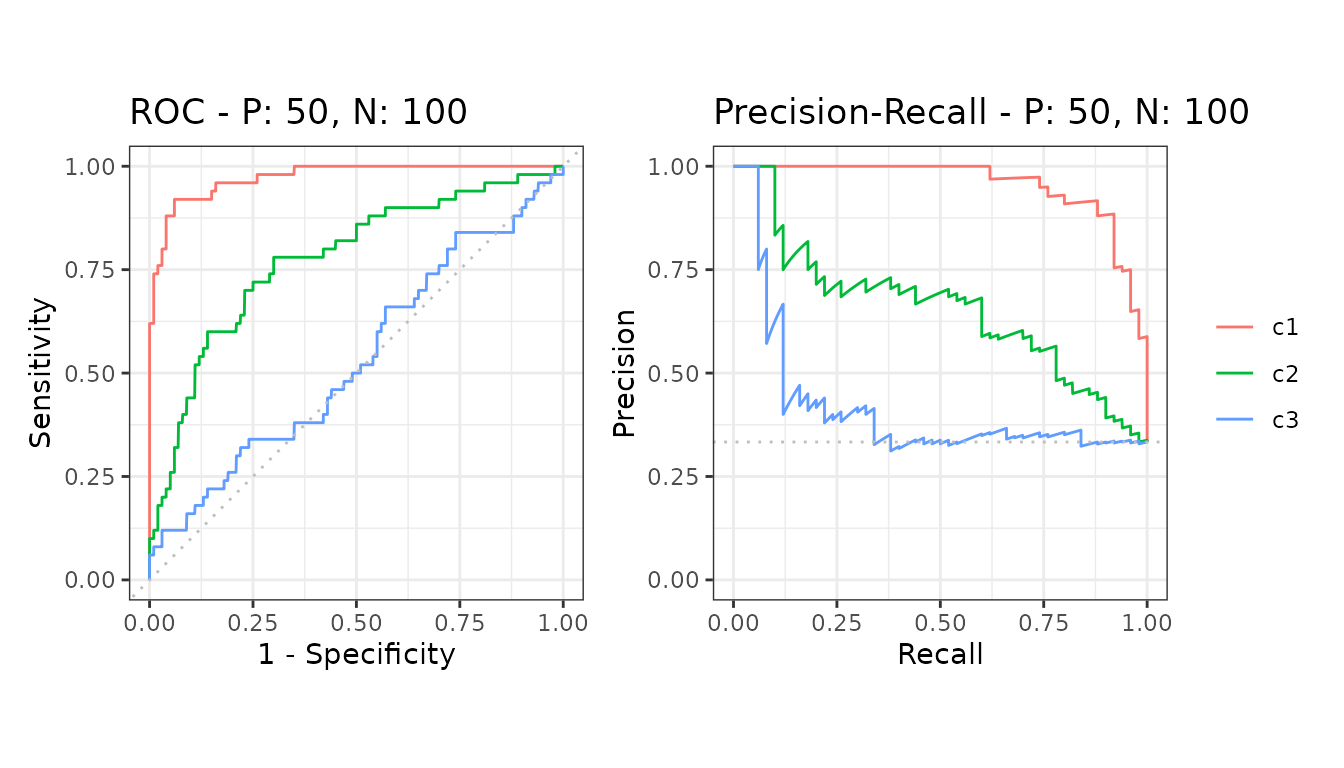
Per-class and macro-averaged areas
auc() reports one row per class and curve type, then the
macro-average of the per-class scores.
| modnames | dsids | curvetypes | aucs | baselines |
|---|---|---|---|---|
| c1 | 1 | ROC | 0.9732000 | 0.5000000 |
| c1 | 1 | PRC | 0.9558435 | 0.3333333 |
| c2 | 1 | ROC | 0.7758000 | 0.5000000 |
| c2 | 1 | PRC | 0.6550357 | 0.3333333 |
| c3 | 1 | ROC | 0.5336000 | 0.5000000 |
| c3 | 1 | PRC | 0.4162555 | 0.3333333 |
| macro-average | 1 | ROC | 0.7608667 | 0.5000000 |
| macro-average | 1 | PRC | 0.6757116 | 0.3333333 |
macro = FALSE leaves the average out and reports the
classes alone.
The average weights every class equally by default, so a class with
ten observations counts as much as one with a thousand.
macro_weight = "prevalence" weights each class by its size
instead.
| modnames | dsids | curvetypes | aucs | baselines |
|---|---|---|---|---|
| c1 | 1 | ROC | 0.9732000 | 0.5000000 |
| c1 | 1 | PRC | 0.9558435 | 0.3333333 |
| c2 | 1 | ROC | 0.7758000 | 0.5000000 |
| c2 | 1 | PRC | 0.6550357 | 0.3333333 |
| c3 | 1 | ROC | 0.5336000 | 0.5000000 |
| c3 | 1 | PRC | 0.4162555 | 0.3333333 |
| macro-average-weighted | 1 | ROC | 0.7608667 | 0.5000000 |
| macro-average-weighted | 1 | PRC | 0.6757116 | 0.3333333 |
Use the uniform average when every class matters equally - usually
the case when the rare classes are the interesting ones - and the
weighted average when you want the average case. Other packages call
these roc_aunu and roc_aunp.